

News
Sport and Character
There is a moment in almost every Grammar sporting season that never appears on a scoreboard. It might happen on a cold Wednesday afternoon when the football team is down by six goals to St Pat’s and a player still sprints to make a tackle no one will remember. It might happen courtside when a basketball captain quietly pulls aside a teammate who has just missed an easy shot and says, “Don’t disappear now! We still need you.” Or perhaps it unfolds after the 1500m race has finished, when exhausted students gather not around the winner, but around the finish line to clap the last athlete to cross the line, after struggling throughout the race, but finding the courage to finish anyway. Those are the moments that stay with you.
Schools often celebrate sport through premiership photos, medal counts and flags hung proudly in gymnasiums, and Grammar is no exception. I believe there is also a deeper value in school sport that has very little to do with trophies. Long after scores are forgotten, young people carry with them the invisible lessons sport quietly teaches: resilience, humility, discipline, leadership, perseverance, and the complicated art of belonging to something bigger than yourself.
I have come to believe that school sport is one of the few places left where young people regularly experience both triumph and disappointment in real time, in public, and alongside others. There is no “undo” or “reset” button. No edited highlight reel. No carefully filtered version of events. No avatar to play the game behind. Just effort, emotion and consequence, and perhaps that is precisely why it matters so much.
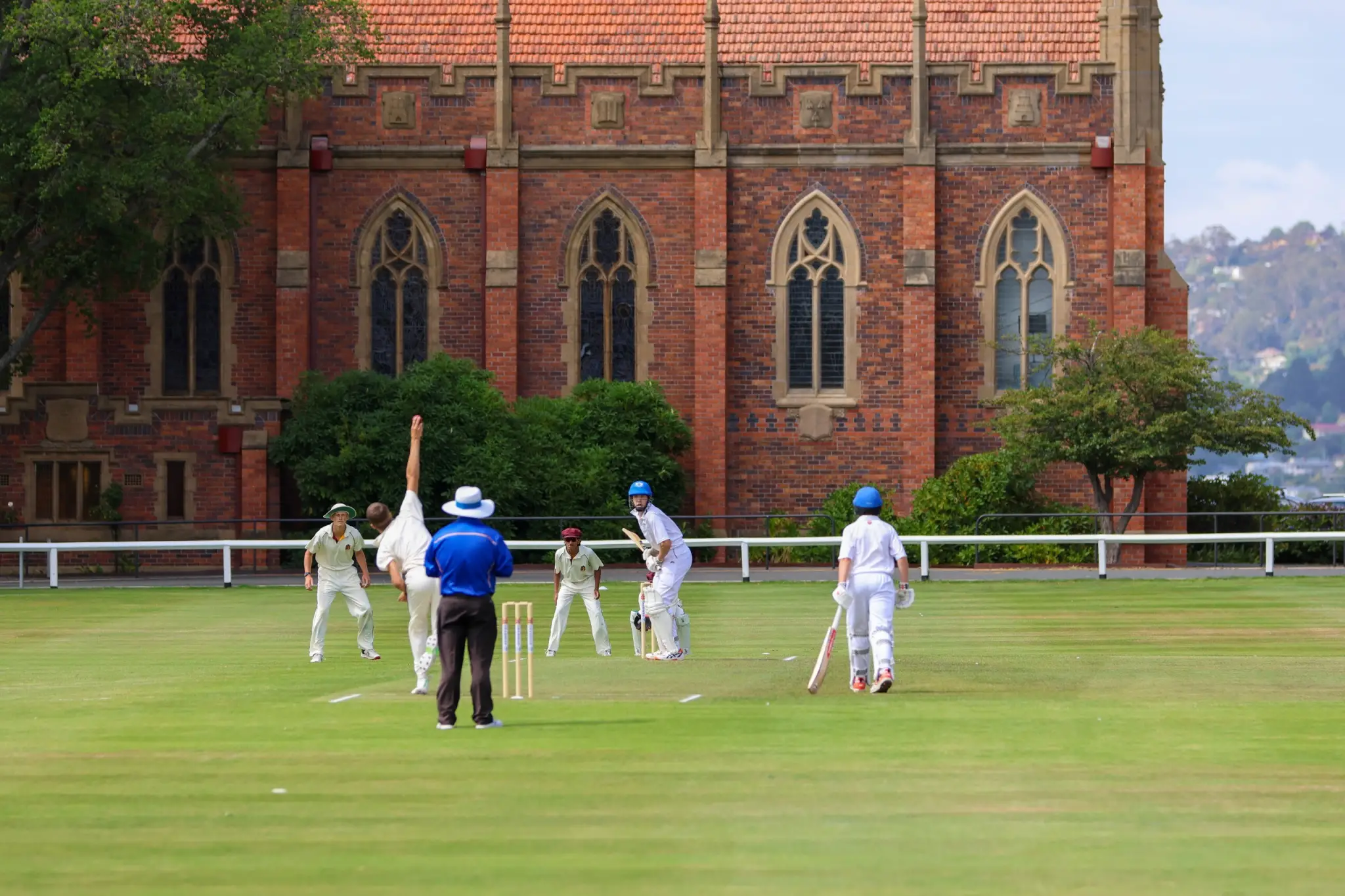
I still remember a student from a few years ago who desperately wanted to make the first XI cricket team. He trained relentlessly through pre-season, stayed behind after sessions, and studied the game with an intensity that suggested selection would surely follow. When the team list was posted each week, his name wasn’t there.
He was devastated. What struck me, however, was not the disappointment itself but what happened afterwards. Each week he arrived at training early. Bat and pads clean and ready. No complaints. No dramatic exit. Over the season he became one of the most dependable players in the School. Not because he was the most talented, but because he learned how to respond when life did not go his way. He told me his greatest achievement at school was finally getting to wear the 1sts blue, black and white cricket cap and the impact he had on the team was immeasurable. That lesson is very difficult to teach in a classroom.
Sport introduces young people to failure in manageable doses. A dropped catch. A missed penalty. A race lost by fractions of a second. These moments sting, but they also reveal character. Students begin to understand that setbacks are not verdicts or life sentences; they are invitations to grow.
In an age where young people often feel enormous pressure to appear successful at all times, sport remains refreshingly honest. The scoreboard tells the truth. Sometimes you were good enough. Sometimes you were not. The challenge then becomes learning how to carry yourself either way.
Winning, of course, can teach important lessons too, provided it is handled correctly. The best school teams I have seen were not always the most talented. They were the groups where students learned that individual brilliance means very little without teamwork, sacrifice, trust and accountability. It is often said that a team is only as good as its weakest link, but it is the teams that strengthen their weakest links and not just try and hide them that usually succeed.
Team sport has an extraordinary way of confronting selfishness. A student who refuses to defend eventually discovers teammates resent it and finds themselves starved of the ball in attack. A gifted player who never passes soon finds themselves isolated with no one to work with. Conversely, students who encourage others, work hard and remain dependable become invaluable, regardless of natural ability. There is something deeply formative about learning that your actions affect the group.
Many students discover leadership this way; not through titles or speeches, but through small acts repeated consistently. Carrying equipment without being asked. Encouraging younger players. Taking risks and owning mistakes publicly. Remaining calm when others panic.
The most respected captains are rarely the loudest. I once watched a senior student lead a football team through a difficult season in which victories were scarce. After another heavy loss, while frustration simmered around the team, he stayed behind helping put away goal post pads and collecting dirty jerseys before quietly checking on a teammate who had played poorly. No grand gestures. No inspirational monologue. Just maturity. That, too, is leadership.
Sport also gives students something increasingly precious: community. Schools can be daunting places. Adolescence is often filled with uncertainty about identity and belonging. Yet within sporting teams, students frequently find connection across year levels, backgrounds and friendship groups. They learn the comfort of shared rituals: bus trips to away games in Hobart, Burnie and Devonport; muddy uniforms gripped tightly as the school war cry is belted out; celebrations that feel enormous even if nobody outside the school notices.
For some students, the sporting field becomes the first place they genuinely feel seen. Importantly, this sense of belonging is not reserved for elite athletes. At Grammar we offer a plethora of sports for all students to be involved in and some of the most meaningful school sporting experiences involve students who would never describe themselves as “sporty” at all. The student persuaded to try hockey despite never picking up a stick before. The unassuming table tennis players who quietly went about their business to win Grammar’s first NSATIS Table Tennis Premiership. The cross-country runner who finishes well behind the leaders but discovers they are capable of far more than they believed just by finishing the course. School sport reminds young people that participation itself carries value.
Of course, there are frustrations. Wet weather and cancelled games. Early morning starts at netball or rowing training to catch the calm water. Injuries. Selection disappointments. Difficult losses. Yet perhaps these inconveniences are part of the education too. Young people learn commitment by showing up when conditions are unpleasant. They learn discipline by training when motivation fades. They learn humility by realising effort does not always guarantee reward. And occasionally, they learn grace.
Years from now, very few students will remember the exact score of a mid-season fixture. But many will remember the teacher who believed in them, the teammate who encouraged them after failure, or the moment they discovered they could endure more than they thought possible. That is the enduring gift of school sport. Not the trophies in cabinets or the records in archives, but the quiet shaping of character through effort, adversity, teamwork and shared experience.
Mr Craig Slavin, Head of Sporting Programs